LAV PRATAP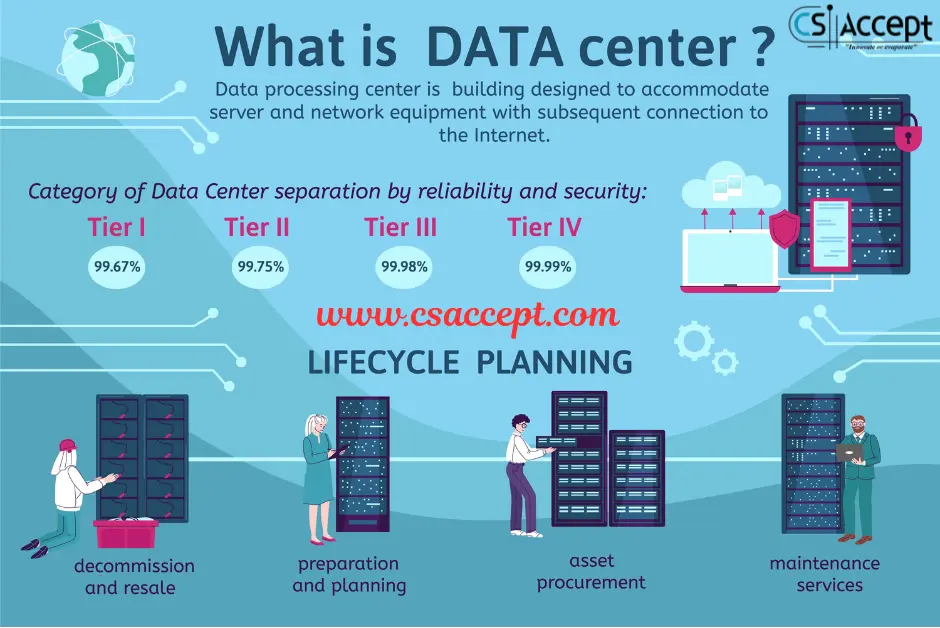
What is a Data Center?
A Data Center is a highly secure facility that houses servers, storage systems, and networking equipment used to manage and deliver digital services. It provides the power, cooling, connectivity, and security required to keep applications, websites, and cloud systems running 24×7. Every online service—from banking transactions to video streaming—relies on data centers for uninterrupted performance.
A Data Center is a large facility (or a dedicated room/building) used to store, manage, process, and distribute large amounts of data. It contains servers, storage devices, networking equipment, power systems, cooling infrastructure, and security tools that allow organizations to run applications, host websites, manage cloud services, store databases, and ensure continuity of IT operations.
Why Data Centers Are Important
Data centers play a crucial role in supporting:
- Online applications and websites
- Cloud computing services
- Data storage and backup
- Real-time business operations
- Artificial intelligence and analytics
- E-commerce and digital payments
Without data centers, modern digital life would not function.
How a Data Center Works
A data center operates by connecting users to servers that process, store, and deliver information.
Here’s the basic workflow:
- A user sends a request through the internet.
- The request reaches servers in a data center.
- Servers process the information or fetch stored data.
- Networking equipment routes the response back to the user.
- Power and cooling systems ensure continuous operation.
- Security layers protect the infrastructure from physical and cyber threats.
History of Data Centers
The concept of data centers evolved over several decades:
1. 1940s–1960s: Early Computer Rooms
-
Large mainframe machines like ENIAC were kept in dedicated rooms.
-
Required heavy cooling and electrical infrastructure.
-
Used mostly by government and large universities.
2. 1970s–1980s: Mini Computers
-
Rise of IBM mainframes and mini computers.
-
Companies started building internal computer rooms.
-
Networking began with ARPANET (precursor to the Internet).
3. 1990s: Birth of Modern Data Centers
-
Internet boom created demand for hosting websites.
-
Companies established internal IT data centers.
-
Rise of client–server model (PCs connected to servers).
4. 2000s: Colocation & Early Cloud
-
Third-party companies began offering colocation data centers.
-
Amazon launched AWS (2006), starting the cloud revolution.
5. 2010s–Present: Cloud & Hyperscale Data Centers
-
Major cloud companies built global data centers.
Examples: AWS, Google Cloud, Microsoft Azure, Meta -
Hyperscale data centers store massive amounts of data.
-
Focus on virtual servers, containerization, energy efficiency.
Core Components of a Data Center
1. IT Infrastructure
- High-performance servers
- Storage devices
- Network switches, routers, firewalls
2. Power Systems
- UPS units
- Diesel generators
- Power distribution systems
3. Cooling & Environmental Control
- Precision air conditioning
- Hot-aisle/cold-aisle management
- Temperature and humidity sensors
4. Physical & Cyber Security
- Biometric access controls
- CCTV surveillance
- Fire detection and suppression
- Encryption and threat protection
5. Network Connectivity
-
Fiber optics
-
High-speed internet connections
6. Software Infrastructure
-
Virtualization tools (VMware, Hyper-V)
-
Cloud management systems
-
Monitoring tools
-
Types of Data Centers
1. Enterprise Data Center
Owned and operated by a company for its internal IT needs.
2. Colocation Data Center
Organizations rent space and place their own equipment in a third-party facility.
3. Cloud Data Center
Fully virtualized digital infrastructure supplied by cloud providers like AWS, Google Cloud, and Microsoft Azure.
4. Hyperscale Data Center
Massive facilities supporting high-volume services such as social media platforms, search engines, and global cloud networks.
5. Edge Data Center
Smaller facilities placed close to users to reduce delay in data processing and delivery.
Data Center Tier Classification
Data centers are rated by reliability and uptime:
| Tier | Uptime | Details |
|---|---|---|
| Tier I | 99.67% | Basic infrastructure |
| Tier II | 99.75% | Partial redundancy |
| Tier III | 99.98% | Can operate during maintenance |
| Tier IV | 99.99% | Fully fault-tolerant |
Lifecycle of a Data Center
A data center goes through several essential stages:
1. Planning & Design
Capacity estimation, equipment selection, power requirements, and network design.
2. Asset Procurement
Purchase of servers, storage units, networking devices, power systems, and cooling equipment.
3. Installation & Deployment
Rack setup, cabling, system configuration, and connectivity establishment.
4. Monitoring & Maintenance
Performance tracking, software updates, hardware inspections, and security audits.
5. Decommissioning
Secure removal, data wiping, recycling, or sale of outdated equipment.
Real-World Examples
- Google Data Centers: Store search, Gmail, YouTube, and cloud data.
- Amazon AWS Data Centers: Power cloud services for companies like Netflix and Airbnb.
- Microsoft Azure Data Centers: Support global enterprise applications and Office 365.
- Meta Data Centers: Store billions of posts, messages, and videos.
Simple Example for Understanding
When you upload a photo to Instagram:
- Your device sends the photo to a data center.
- The server saves it in secure storage.
- The system updates your profile.
- The photo is delivered instantly to your followers.
All this takes place inside a data center—within milliseconds.
Example Scenario
You upload a photo to Instagram.
Here’s what happens:
-
Your phone sends the photo to a data center.
-
The server stores your photo in distributed storage.
-
Database servers update your account.
-
Content delivery networks (CDN) distribute the photo globally.
-
Friends can now see your photo instantly.
This entire process happens in milliseconds—powered by data centers.
Conclusion
A data center is the backbone of digital operations, enabling uninterrupted access to data and applications. As digital services continue to grow, data centers remain essential for ensuring speed, security, and reliability for businesses, governments, and everyday users.