LAV PRATAP
csaccept.com is a computer awareness website dedicated to providing reliable and easy-to-understand information about computer technology and digital safety. The website focuses on educating students, beginners, and general users about computer basics, cyber security, emerging technologies, and practical IT skills. Through informative articles, quizzes, and real-life examples, csaccept.com aims to increase digital literacy and help users stay safe and confident in today’s technology-driven world.
Artificial Intelligence : The Choice of the New Generation
1. Introduction to Artificial Intelligence
Artificial Intelligence (AI) is one of the most revolutionary technologies of the 21st century. It has transformed the way humans interact with machines and how machines interact with the world. Artificial Intelligence refers to the simulation of human intelligence in machines that are programmed to think, learn, reason, and make decisions like humans. These intelligent systems are capable of performing tasks such as speech recognition, visual perception, language translation, problem-solving, and decision-making.
For the new generation, Artificial Intelligence is not just a technology; it is a lifestyle, a career opportunity, and a symbol of progress. Young people today grow up using smartphones, smart assistants, recommendation systems, and intelligent applications without even realizing that AI is working behind the scenes. This deep integration of AI into daily life has made it extremely attractive and relevant to the new generation.
The popularity of Artificial Intelligence among the new generation is driven by innovation, automation, creativity, efficiency, and future career prospects. AI is shaping industries, education systems, businesses, healthcare, entertainment, and even government operations. As a result, it has become one of the most preferred and respected fields of study and work for students and professionals worldwide.
2. Evolution and History of Artificial Intelligence
To understand why Artificial Intelligence is the choice of the new generation, it is important to understand how AI evolved over time.
2.1 Early Concepts of Artificial Intelligence
The idea of intelligent machines dates back to ancient times when philosophers imagined mechanical beings capable of thinking. However, the scientific foundation of AI began in the mid-20th century.
In 1950, British mathematician and computer scientist Alan Turing introduced the concept of machine intelligence and proposed the famous Turing Test, which evaluates a machine’s ability to exhibit intelligent behavior equivalent to a human.
2.2 Birth of Artificial Intelligence
The term Artificial Intelligence was officially coined in 1956 at the Dartmouth Conference by John McCarthy. This conference is considered the birthplace of AI as an academic discipline. Early AI research focused on problem-solving, symbolic reasoning, and game playing.
2.3 AI Winters and Revivals
AI faced several challenges due to limited computing power, lack of data, and unrealistic expectations. These periods of reduced funding and interest are known as AI Winters. However, with advancements in hardware, the internet, big data, and cloud computing, AI experienced strong revivals.
2.4 Modern AI Era
The modern AI era began in the 2000s and accelerated after 2010 due to:
- Powerful processors (GPUs and TPUs)
- Availability of massive data
- Advances in machine learning and deep learning
- Open-source AI frameworks
Today, Artificial Intelligence is one of the fastest-growing technologies and a key driver of innovation.
3. Why Artificial Intelligence is the Choice of the New Generation
The new generation prefers Artificial Intelligence for several important reasons.
3.1 Alignment with Digital Lifestyle
The new generation lives in a digital ecosystem. Smartphones, social media, online education, digital payments, and smart devices are integral parts of their lives. AI enhances all these technologies, making them faster, smarter, and more personalized.
3.2 Innovation and Creativity
AI encourages innovation. Young minds are attracted to AI because it allows them to create intelligent applications, games, robots, websites, and automation tools. AI-based creativity includes:
- AI-generated art
- Music composition
- Content writing
- Video editing
- Graphic design
3.3 Automation and Efficiency
AI automates repetitive and time-consuming tasks, allowing humans to focus on creativity and decision-making. This efficiency strongly appeals to the new generation, which values speed and productivity.
3.4 Career Opportunities and High Salaries
Artificial Intelligence offers some of the most high-paying and future-proof careers. AI professionals are in demand across industries, including IT, healthcare, finance, education, manufacturing, and entertainment.
4. Fundamental Concepts of Artificial Intelligence
4.1 Machine Learning
Machine Learning (ML) is a subset of AI that enables machines to learn from data without being explicitly programmed. ML algorithms identify patterns in data and make predictions or decisions.
Examples:
- Spam email detection
- Movie recommendations
- Credit scoring systems
4.2 Deep Learning
Deep Learning is a subset of Machine Learning based on artificial neural networks inspired by the human brain. It is used in:
- Image recognition
- Speech recognition
- Self-driving cars
4.3 Natural Language Processing (NLP)
NLP allows machines to understand, interpret, and generate human language. It powers:
- Chatbots
- Voice assistants
- Language translation tools
4.4 Computer Vision
Computer Vision enables machines to interpret visual data such as images and videos. Applications include:
- Face recognition
- Medical image analysis
- Surveillance systems
5. Role of Artificial Intelligence in Daily Life
Artificial Intelligence is deeply embedded in everyday activities.
5.1 Smart Assistants
Virtual assistants like Google Assistant, Siri, and Alexa help users perform tasks using voice commands.
5.2 Social Media Platforms
AI algorithms analyze user behavior to recommend posts, videos, and advertisements.
5.3 Online Shopping and E-commerce
AI recommends products, predicts demand, manages inventory, and improves customer experience.
5.4 Banking and Finance
AI is used for fraud detection, customer support, loan approvals, and stock market analysis.
5.5 Transportation
AI powers navigation systems, ride-sharing apps, traffic prediction, and autonomous vehicles.
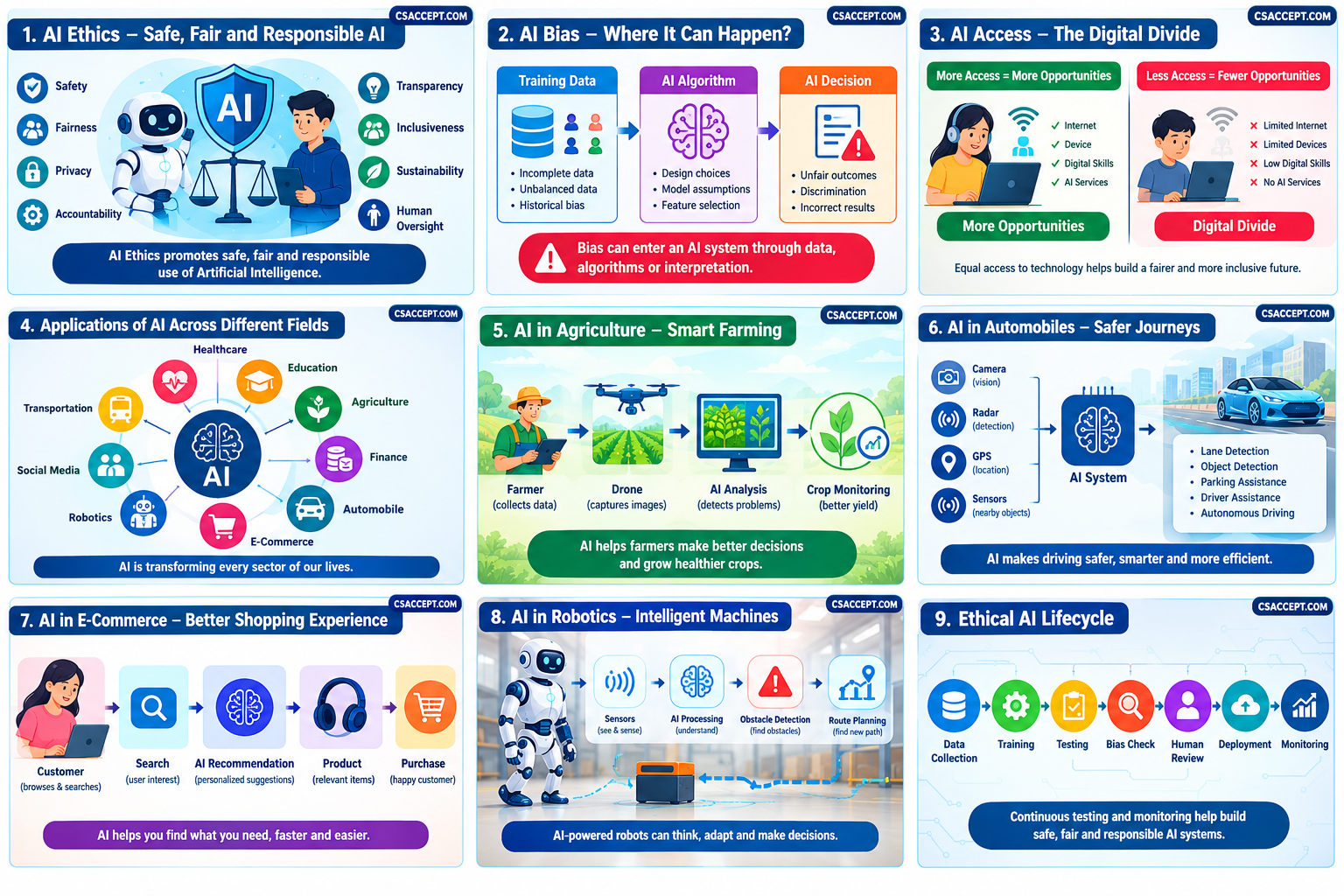
6. Artificial Intelligence in Education
Education is one of the fields most influenced by AI.
6.1 Personalized Learning
AI-based platforms provide customized learning experiences based on student performance.
6.2 Smart Assessments
AI evaluates exams, assignments, and quizzes automatically with accuracy.
6.3 Virtual Tutors
AI-powered tutors assist students 24/7, answering questions and explaining concepts.
6.4 Example
An AI-based learning app analyzes a student’s weak areas in mathematics and provides targeted practice questions, improving learning efficiency.
7. Artificial Intelligence in Healthcare
AI has revolutionized healthcare.
7.1 Disease Diagnosis
AI analyzes medical images and reports to detect diseases early.
7.2 Robotic Surgery
AI-assisted robots help doctors perform complex surgeries with precision.
7.3 Predictive Healthcare
AI predicts disease risks based on patient data.
7.4 Example
AI systems detect cancer from X-ray or MRI images faster and more accurately than traditional methods.
8. Artificial Intelligence in Business and Industry
AI enhances productivity and decision-making.
8.1 Automation
AI automates manufacturing, logistics, and customer support.
8.2 Data Analysis
Businesses use AI to analyze large datasets for insights.
8.3 Marketing
AI helps in targeted advertising and customer behavior analysis.
9. Artificial Intelligence in Entertainment and Media
AI personalizes entertainment experiences.
9.1 Streaming Platforms
Netflix and YouTube recommend content based on user preferences.
9.2 Gaming
AI controls non-player characters (NPCs) and adapts game difficulty.
9.3 Content Creation
AI generates music, videos, images, and scripts.
10. Suitable Examples of Artificial Intelligence
10.1 Chatbots
Chatbots provide instant customer support on websites and apps using NLP.
10.2 Google Maps
AI analyzes traffic data to suggest the fastest routes.
10.3 Recommendation Systems
Amazon and Netflix use AI to recommend products and movies.
11. Ethical Issues and Challenges of Artificial Intelligence
Despite its advantages, AI has challenges.
11.1 Data Privacy
AI systems collect and analyze large amounts of personal data.
11.2 Job Displacement
Automation may replace certain jobs.
11.3 Bias and Fairness
AI can inherit biases from training data.
11.4 Security Risks
AI can be misused for cybercrime and misinformation.
12. Artificial Intelligence and the Future Generation
The future generation will depend heavily on AI.
12.1 Smart Cities
AI will manage traffic, energy, and public services.
12.2 Autonomous Systems
Self-driving cars and drones will become common.
12.3 Human-AI Collaboration
AI will assist humans rather than replace them.
13. Career Opportunities in Artificial Intelligence
Popular AI careers include:
- AI Engineer
- Data Scientist
- Machine Learning Engineer
- Robotics Engineer
- AI Researcher
These careers offer global demand and high salaries.
14. Why Students Should Learn Artificial Intelligence
- Future-ready skills
- High demand in the job market
- Opportunities for innovation
- Global career scope
15. Conclusion
Artificial Intelligence is truly the choice of the new generation. It represents innovation, efficiency, creativity, and future growth. From daily life applications to advanced scientific research, AI is transforming every aspect of society. With suitable examples like chatbots, recommendation systems, and smart assistants, it is clear that AI is not just a trend but a necessity for the modern world.
The new generation’s interest in Artificial Intelligence reflects their vision for a smarter, faster, and more intelligent future. Learning and adopting AI today will empower individuals and societies to thrive in the digital era.