LAV PRATAP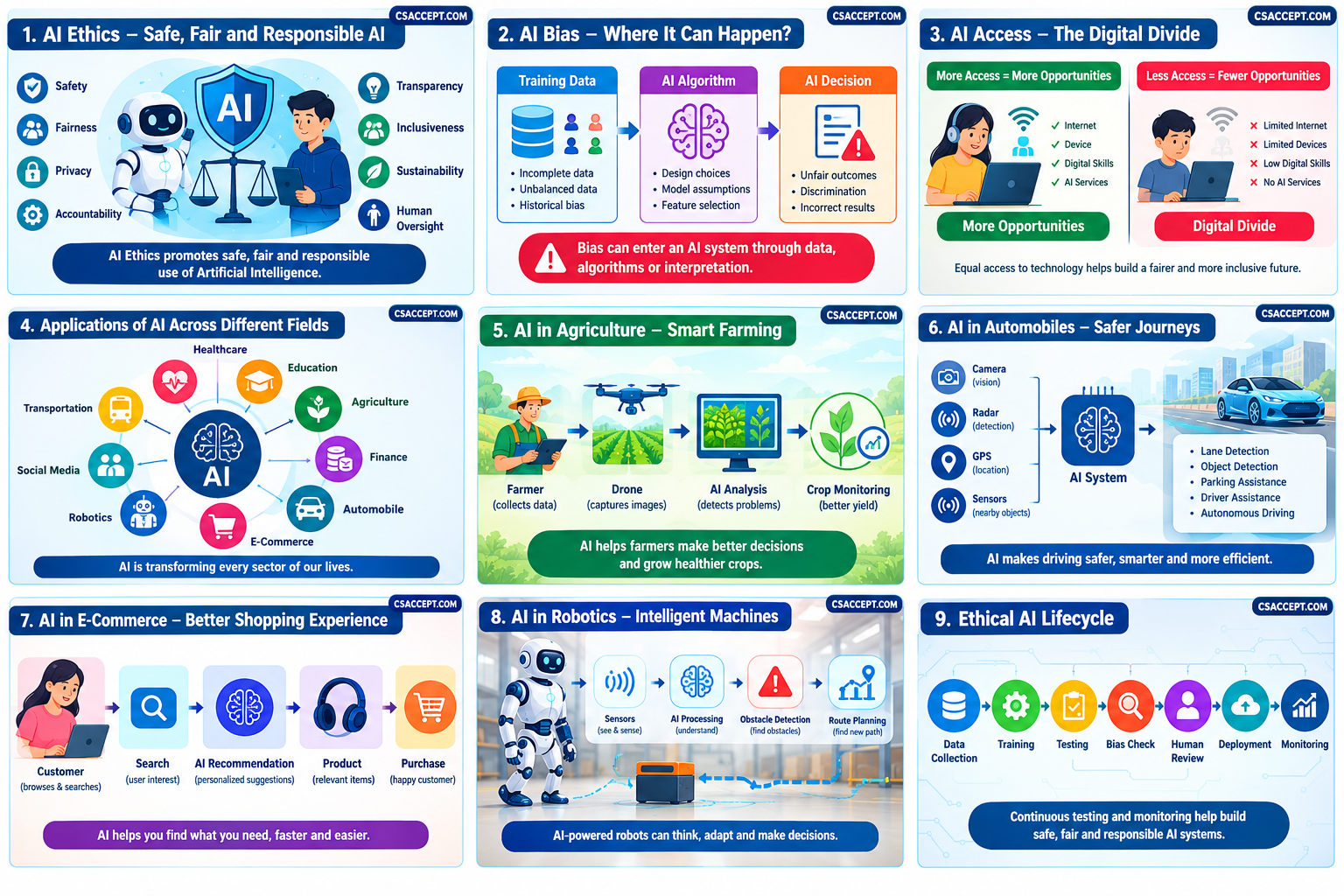
csaccept.com is a computer awareness website dedicated to providing reliable and easy-to-understand information about computer technology and digital safety. The website focuses on educating students, beginners, and general users about computer basics, cyber security, emerging technologies, and practical IT skills. Through informative articles, quizzes, and real-life examples, csaccept.com aims to increase digital literacy and help users stay safe and confident in today’s technology-driven world.
 Facebook ………………..
  Instagram ……………..
  Twitter ( X ) ……………..
  YouTube
AI Ethics and Applications of Artificial Intelligence
Artificial Intelligence (AI) has become an important part of modern life. We use AI directly or indirectly while searching on the internet, watching videos, shopping online, using social media, travelling, studying, using banking applications and even while using smartphones.
AI can make machines intelligent enough to perform tasks that normally require human intelligence. However, simply making an AI system powerful is not enough. AI should also be developed and used in a fair, safe, responsible and transparent way.
This is where AI Ethics becomes important.
1. What is AI Ethics?
AI Ethics is a set of moral principles, rules and guidelines that help us develop and use Artificial Intelligence responsibly.
In simple words:
AI Ethics tells us how AI should be designed and used so that it benefits people without causing unnecessary harm.
Ethics generally refers to principles that help us decide what is right or wrong, fair or unfair, and responsible or irresponsible.
For example, suppose an AI system is used to select students for a scholarship. If the system unfairly rejects students because of their gender, language, location or background, then the AI system may be considered unethical.
Therefore, AI should not only be intelligent; it should also be fair, responsible and trustworthy.
Simple Example
Imagine two students apply for the same scholarship.
- Student A has excellent academic performance.
- Student B also has excellent academic performance.
If an AI system rejects Student B only because of information unrelated to academic ability, such as gender or social background, the system may be showing AI bias.
This is why ethics must be considered while designing, training and using AI systems.
2. Why Do We Need AI Ethics?
AI systems can influence important decisions related to:
- Education
- Healthcare
- Employment
- Banking
- Transportation
- Security
- Social media
- Online shopping
- Finance
- Government services
An incorrect or unfair AI decision can therefore affect people’s lives.
AI Ethics helps us ask important questions:
- Is the AI system fair?
- Is the data being used responsibly?
- Is personal information protected?
- Can humans understand the AI decision?
- Can the system make mistakes?
- Who is responsible when AI causes harm?
- Does AI treat different groups equally?
- Is AI accessible to everyone?
- Does AI reduce or increase human inequality?
- Is AI being used for a beneficial purpose?
3. Main Areas of AI Ethics
AI ethics covers many different areas. Two important concepts discussed in this chapter are:
- AI Bias
- AI Access
Other important ethical principles include:
- Fairness
- Privacy
- Transparency
- Accountability
- Safety
- Security
- Human control
- Inclusiveness
- Environmental responsibility
4. AI Bias
What is AI Bias?
AI Bias occurs when an AI system produces unfair, inaccurate or systematically different outcomes for certain people or groups.
AI systems learn from data. If the training data is incomplete, unbalanced or biased, the AI system may learn and reproduce those problems.
Simple Definition
AI bias is the tendency of an AI system to produce unfair or unequal results because of problems in data, algorithms or the way results are interpreted.
Example of AI Bias
Suppose an AI recruitment system is trained mostly using historical hiring data from one particular group.
If the historical data contains unfair hiring patterns, the AI system may learn those patterns and give preference to similar candidates.
The problem may not be that the AI intentionally discriminates. The problem can originate from the data used to train the AI.
5. Sources of AI Bias
AI bias can enter a system at different stages.
1. Bias in Training Data
If training data does not properly represent the real population, the AI may produce unfair results.
Example:
A facial recognition system trained mostly using images from one demographic group may perform differently for people who are poorly represented in its training data.
2. Bias in Data Collection
The way information is collected can also introduce bias.
For example, if a survey is conducted only among people living in cities, its results may not represent people living in rural areas.
3. Algorithmic Bias
The design of an algorithm can sometimes cause certain groups to receive different outcomes.
4. Interpretation Bias
Even correct AI results can be interpreted incorrectly by humans.
5. Historical Bias
Past human decisions may contain unfair patterns. If AI learns from historical information, it may reproduce those patterns.
6. How Can AI Bias Be Reduced?
AI bias can be reduced through:
- Using diverse and representative datasets
- Checking data quality
- Testing AI systems with different groups
- Regularly auditing AI models
- Including people from different backgrounds in AI development
- Monitoring AI decisions
- Allowing human review of important decisions
- Correcting identified sources of bias
Important Point
AI does not automatically become fair simply because a computer is making the decision.
Humans must carefully design, test and monitor AI systems.
7. AI Access
What is AI Access?
AI Access refers to the ability of different people and communities to access and benefit from AI technologies.
AI-powered services often require:
- Internet connectivity
- Smartphones or computers
- Digital literacy
- Electricity
- Software
- Financial resources
- Technical knowledge
Not everyone has equal access to these resources.
This can create a digital divide.
8. Example of AI Access
Imagine an AI-powered education platform that provides personalized learning.
Students with:
- smartphones,
- high-speed internet,
- computers,
- and paid subscriptions
may receive more opportunities than students who lack these resources.
Therefore, technological development can sometimes increase the gap between people who have access to technology and those who do not.
9. How Can AI Access Be Improved?
AI can become more inclusive through:
- Affordable technology
- Better internet connectivity
- Digital literacy programs
- Accessible educational resources
- Local-language AI systems
- Assistive technologies for people with disabilities
- Public digital infrastructure
- Low-cost AI services
- Training programs
Example
AI-based educational content available in Hindi and other Indian languages can help more students access digital learning.
10. AI Ethics: Important Principles
AI Ethics is broader than only bias and access.
1. Fairness
AI should treat people fairly and should not discriminate unfairly.
2. Privacy
Personal information should be collected and used responsibly.
3. Transparency
People should understand, where practical, how an important AI-based decision was reached.
4. Accountability
There should be clear responsibility for AI systems and their outcomes.
5. Safety
AI systems should be designed and tested to reduce risks.
6. Security
AI systems and their data should be protected from unauthorized access and misuse.
7. Human Oversight
Humans should remain involved in important decisions where AI mistakes could cause serious harm.
8. Inclusiveness
AI should be designed so that people with different abilities, languages and backgrounds can benefit from it.
9. Environmental Responsibility
AI development should consider energy consumption, electronic waste and other environmental impacts.
11. Why is AI Ethics Important?
Ethical AI can provide many benefits.
1. Builds Trust
People are more likely to trust AI when they understand that it is being used responsibly.
2. Reduces Discrimination
Proper testing and monitoring can help identify unfair outcomes.
3. Protects Privacy
Ethical practices encourage responsible handling of personal information.
4. Improves Safety
AI systems can be tested to identify and reduce potential risks.
5. Supports Human Well-being
AI should be developed primarily to support people and society.
6. Improves Decision-Making
When reliable data and appropriate human oversight are used, AI can support better decisions.
7. Supports Sustainable Development
Responsible AI development can consider energy use and environmental effects.
12. Ethical Challenges in Artificial Intelligence
Artificial Intelligence provides many benefits, but it also creates several challenges.
1. Cost to Innovation
Developing safe and responsible AI requires:
- Research
- Testing
- Skilled professionals
- Computing resources
- Data management
- Security measures
These requirements can increase development costs.
However, responsible development is important because reducing short-term costs by ignoring safety or fairness can create larger problems later.
2. Lack of Quality Data
AI systems depend heavily on data.
Poor-quality data can lead to:
- Incorrect predictions
- Unfair outcomes
- Incomplete analysis
- Wrong recommendations
Example
If an AI healthcare model receives incomplete patient information, its prediction may not be reliable.
3. Problems of Integrity
AI systems should use information responsibly.
Problems can occur when:
- Data is manipulated
- Information is intentionally misleading
- AI-generated content is presented deceptively
- AI systems are used for fraudulent activities
4. Lack of Accuracy of Data
Incorrect data can produce incorrect results.
A common principle is:
Garbage In, Garbage Out
This means that if poor-quality information is supplied to a system, the output may also be poor.
5. Bias and Discrimination
AI may produce unfair outcomes when its training data or design contains bias.
This is one of the most important AI ethics challenges.
6. Reduction of Human Contact
Excessive dependence on AI can reduce direct interaction between people.
For example:
- Chatbots replacing some customer interactions
- Automated services replacing some face-to-face assistance
- AI-based systems reducing human involvement in routine activities
AI can improve efficiency, but human interaction remains important in many situations.
7. Violation of Fundamental Human Rights
AI can create risks when it is used irresponsibly in areas involving:
- Privacy
- Freedom
- Personal information
- Employment
- Access to services
- Surveillance
Strong safeguards are therefore important.
8. Negative Impact on Environment
AI systems require computing resources and electricity.
Large AI systems can require significant:
- Computing power
- Data-centre infrastructure
- Electricity
- Cooling resources
AI development should therefore consider environmental sustainability.
9. Loss of Human Decision-Making
If people rely too heavily on AI, they may stop independently evaluating important decisions.
AI should generally be considered a tool to assist human decision-making, rather than automatically replacing human responsibility in every situation.
13. Applications of Artificial Intelligence
Artificial Intelligence is used in many sectors.
| Field | Examples of AI Applications |
|---|---|
| Healthcare | Disease prediction, medical imaging, robotic assistance |
| Transportation | Driver assistance, route planning, autonomous systems |
| Agriculture | Crop monitoring, soil analysis, smart irrigation |
| Education | Automated assessment, learning assistance |
| E-Commerce | Recommendations, chatbots, fraud detection |
| Entertainment | Content recommendations |
| Automobile | Driver-assistance and autonomous driving technologies |
| Social Media | Content moderation and recommendations |
| Security | Threat detection and monitoring |
| Finance | Fraud detection and financial analysis |
| Gaming | Intelligent game characters and game analysis |
| Astronomy | Data analysis and identification of celestial objects |
| Robotics | Navigation, object detection and automation |
14. AI in Healthcare
AI is increasingly used to assist healthcare professionals.
Applications
- Medical image analysis
- Disease prediction
- Patient monitoring
- Drug research
- Health-data analysis
- Robotic assistance
- Appointment management
Example
AI can help analyse medical images and identify patterns that may require further examination by healthcare professionals.
Important Ethical Point
Healthcare AI should be carefully tested because incorrect predictions can have serious consequences.
15. AI in Transportation
AI is used in modern transportation systems.
Applications
- Traffic prediction
- Route optimization
- Driver assistance
- Parking assistance
- Autonomous vehicle research
- Fleet management
- Predictive maintenance
Example
Navigation applications can analyse traffic information and suggest alternative routes.
16. AI in Agriculture
Artificial Intelligence can help farmers analyse agricultural information.
Applications
- Crop monitoring
- Soil analysis
- Pest detection
- Disease identification
- Smart irrigation
- Weather analysis
- Drone-based crop monitoring
- Weed detection
Example
A camera-equipped drone can capture images of agricultural fields. AI can analyse these images to identify areas where crops may require attention.
17. AI in Education
AI is changing the way students learn and teachers manage educational activities.
Applications
- Personalized learning
- Automated assessment
- Educational chatbots
- Learning recommendations
- Language learning
- Administrative automation
- Accessibility tools
Example
An AI learning system can analyse a student’s performance and recommend additional practice questions on topics where the student needs improvement.
AI + Teacher
AI can assist teachers, but teachers continue to play an important role in:
- Understanding students
- Providing emotional support
- Classroom management
- Explaining difficult concepts
- Making educational judgments
18. AI in E-Commerce
E-Commerce is one of the major areas where AI is widely used.
A. Personalized Shopping
AI can analyse information such as:
- Previous searches
- Products viewed
- Purchase history
- User preferences
It can then provide personalized product recommendations.
Example
If a customer frequently searches for computer accessories, an online shopping platform may recommend keyboards, mice, headphones or other related products.
B. AI-Powered Assistants
Chatbots and virtual assistants can help customers with:
- Product information
- Order status
- Frequently asked questions
- Returns
- Basic customer support
Example
A customer can ask:
“Where is my order?”
An AI-powered chatbot may provide the latest available order information.
C. Fraud Prevention
AI can help detect suspicious transactions and unusual patterns.
For example, if a payment system detects an unusual transaction pattern, it may flag the transaction for additional verification.
AI can also assist platforms in identifying suspicious reviews or activities.
19. AI in Automobiles
Modern automobiles increasingly use AI and machine learning.
Applications
- Driver assistance
- Object detection
- Lane detection
- Parking assistance
- Traffic sign recognition
- Driver monitoring
- Autonomous driving research
Self-driving vehicle systems can combine information from technologies such as:
- Cameras
- Radar
- GPS
- Sensors
- Maps
- Computing systems
The AI system processes information from these sources to understand the surrounding environment and support driving decisions.
20. AI in Social Media
Many social media platforms use AI and machine learning.
Major applications include:
- Content recommendation
- Spam detection
- Fraud detection
- Content moderation
- Translation
- Image recognition
- Personalized feeds
- Detection of potentially harmful content
Facebook and AI
AI can be used to understand and classify content and to provide personalized experiences.
Language technologies can also support translation and content understanding.
Twitter/X and AI
AI and machine learning can be used for areas such as:
- Spam detection
- Fraud detection
- Content moderation
- Ranking and recommendation
21. AI in Robotics
Robotics and AI are closely connected.
A traditional robot may simply follow a fixed set of instructions.
An AI-powered robot can use sensors and intelligent software to:
- Detect objects
- Understand surroundings
- Identify obstacles
- Plan routes
- Make decisions
- Adapt to changing conditions
Example
A warehouse robot may detect an obstacle in its path and calculate another route to reach its destination.
22. AI in Finance
Financial institutions use AI and machine learning for various tasks.
Applications
- Fraud detection
- Risk analysis
- Customer service
- Financial forecasting
- Transaction monitoring
- Credit-related analysis
- Automated assistance
Example
If a banking system detects unusual transaction behaviour, it can flag the activity for further investigation.
23. AI in Entertainment
AI is widely used by entertainment platforms.
Applications
- Movie recommendations
- Music recommendations
- Video recommendations
- Content personalization
- Game development
- Animation
- Content analysis
Example
When a streaming platform recommends another movie based on the content you previously watched, AI and recommendation algorithms may be involved.
24. AI in Gaming
AI has been used in gaming for many years.
AI can control:
- Non-player characters (NPCs)
- Opponents
- Game environments
- Difficulty levels
AI can also be used to analyse player behaviour and create adaptive gaming experiences.
25. AI in Astronomy
Astronomy produces huge amounts of data from:
- Telescopes
- Satellites
- Space missions
- Observatories
AI can help researchers analyse large datasets.
Applications
- Identifying celestial objects
- Analysing astronomical images
- Finding patterns in telescope data
- Supporting planet searches
- Studying stars and galaxies
AI can help researchers process information that would be difficult to examine manually at the same scale.
26. AI in Security
AI can assist in security-related activities such as:
- Threat detection
- Anomaly detection
- Cybersecurity monitoring
- Object detection
- Suspicious activity detection
AI-based systems can process large quantities of information and identify patterns that may require human attention.
27. AI and Cybersecurity
AI is increasingly important in cybersecurity.
AI can help detect:
- Suspicious login attempts
- Malware patterns
- Unusual network activity
- Phishing attempts
- Fraudulent transactions
- Security anomalies
At the same time, AI can also be misused by attackers, which makes responsible development and cybersecurity safeguards important.
28. AI in Daily Life
AI is not limited to laboratories or large companies.
We encounter AI in everyday activities.
Examples
Smartphones
- Voice assistants
- Face recognition
- Camera enhancement
Search Engines
- Search ranking
- Suggestions
- Spam detection
- Spam filtering
- Smart replies
- Writing assistance
Shopping
- Recommendations
- Chatbots
- Fraud detection
Maps
- Route suggestions
- Traffic prediction
Entertainment
- Movie and music recommendations
Social Media
- Personalized content feeds
- Content moderation
29. AI Ethics and Real-Life Example
Consider an AI-based school admission system.
The system receives applications from thousands of students.
If the training data is incomplete or biased, the AI might unintentionally give unfair results.
Therefore, the school should consider:
Data Quality
Is the information accurate?
Fairness
Are students being treated equally?
Privacy
Is student information protected?
Transparency
Can the school understand the important factors behind the decision?
Human Oversight
Can a responsible person review an unusual or disputed case?
This example shows why AI ethics is important even when AI is being used for useful purposes.
30. AI Ethics vs AI Application
| AI Application | Ethical Question |
|---|---|
| Facial Recognition | Is personal privacy protected? |
| Online Shopping | Are recommendations fair and transparent? |
| Healthcare AI | Is the system accurate and properly tested? |
| Recruitment AI | Does it treat candidates fairly? |
| Social Media AI | How is harmful content handled? |
| Education AI | Is student data protected? |
| Autonomous Vehicles | Is the system safe and reliable? |
| Banking AI | Are customers treated fairly? |
31. Advantages of Ethical AI
Ethical AI can help society by:
- Improving trust in technology
- Reducing unfair outcomes
- Protecting personal information
- Supporting safer systems
- Increasing accessibility
- Improving decision support
- Encouraging responsible innovation
- Supporting human well-being
- Reducing misuse of technology
- Promoting sustainable technological development
32. Disadvantages and Risks of Unethical AI
If AI is developed or used irresponsibly, it may result in:
- Privacy violations
- Discrimination
- Incorrect decisions
- Security problems
- Misinformation
- Excessive surveillance
- Job-related disruption
- Digital inequality
- Loss of human oversight
- Environmental concerns
33. AI Ethics – Simple Flow Diagram
How Ethical AI Should Work
Data Collection
↓
Data Quality Check
↓
AI Model Development
↓
Bias & Safety Testing
↓
Human Review
↓
Responsible Deployment
↓
Continuous Monitoring
↓
Improvement
This process helps make AI systems more responsible and reliable.
34. AI Bias – Simple Figure
Sources of AI Bias
Data Collection
↓
Training Data
↓
Algorithm
↓
AI Model
↓
Result
Bias can enter at any stage.
Therefore, AI systems should be checked throughout their lifecycle.
35. AI Access – Digital Divide Figure
People with Greater Technology Access
Internet + Device + Digital Skills + AI Services
⬇
More Opportunities
People with Limited Technology Access
Limited Internet + Limited Devices + Limited Digital Skills
⬇
Fewer Opportunities
This difference is commonly associated with the digital divide.
36. AI Application Cycle
A simple way to understand an AI application is:
Problem
↓
Data
↓
AI Model
↓
Prediction / Decision
↓
Human or System Action
↓
Feedback
↓
Improvement
37. Important AI Ethics Vocabulary
| Term | Meaning |
|---|---|
| AI Ethics | Principles for responsible AI development and use |
| AI Bias | Unfair or systematically unequal AI outcomes |
| AI Access | Ability of people to access and benefit from AI |
| Privacy | Protection of personal information |
| Transparency | Making AI processes or decisions understandable where appropriate |
| Accountability | Responsibility for AI systems and outcomes |
| Fairness | Treating people without unjust discrimination |
| Digital Divide | Gap between people with different levels of access to technology |
| Algorithm | A set of instructions used to solve a problem |
| Dataset | Collection of data used for analysis or AI training |
| Machine Learning | A method through which systems learn patterns from data |
| Automation | Use of technology to perform tasks with reduced human intervention |
38. Key Points to Remember
- AI Ethics provides principles for responsible AI.
- AI should be useful, safe and fair.
- AI Bias can result from data, algorithms or interpretation.
- Poor-quality training data can produce unreliable AI results.
- AI Access is concerned with equal opportunities to benefit from AI.
- Lack of technology access can increase the digital divide.
- Privacy is an important AI ethics issue.
- Transparency helps people understand AI systems where appropriate.
- Human oversight is important for high-impact decisions.
- AI is used in healthcare, agriculture, education, finance, transportation and many other fields.
- AI can assist humans, but responsible human involvement remains important.
- Ethical AI requires continuous testing and monitoring.
39. Short Questions and Answers
Q1. What is AI Ethics?
Answer:
AI Ethics is a collection of moral principles and guidelines that help in the responsible development and use of Artificial Intelligence.
Q2. What is AI Bias?
Answer:
AI Bias occurs when an AI system produces unfair or systematically unequal results because of problems in data, algorithms or interpretation.
Q3. What is AI Access?
Answer:
AI Access refers to the ability of people and communities to access and benefit from Artificial Intelligence technologies.
Q4. What is the digital divide?
Answer:
The digital divide is the gap between people or communities that have access to digital technologies and those that have limited or no access.
Q5. Why is AI Ethics important?
Answer:
AI Ethics is important because it helps promote fairness, privacy, safety, accountability and responsible use of Artificial Intelligence.
Q6. Give two examples of AI in healthcare.
Answer:
AI can be used for medical image analysis and disease prediction.
Q7. Give two applications of AI in agriculture.
Answer:
AI can be used for crop monitoring and identifying crop or soil-related problems.
Q8. How is AI used in E-Commerce?
Answer:
AI is used for personalized recommendations, chatbots, customer support and fraud detection.
Q9. How is AI used in automobiles?
Answer:
AI is used in driver assistance, object detection, parking assistance, route planning and autonomous driving technologies.
Q10. How is AI used in social media?
Answer:
AI can be used for recommendations, translation, spam detection, fraud detection and content moderation.
40. Frequently Asked Questions
What is the main purpose of AI Ethics?
The main purpose is to encourage the development and use of AI in a safe, fair, responsible and beneficial manner.
Is AI always unbiased?
No. AI can produce biased results if the data, algorithm, system design or interpretation contains bias.
Can AI replace humans completely?
AI can automate or assist with many tasks, but human judgment, responsibility, creativity, communication and oversight remain important, particularly in high-impact situations.
Why is data important for AI?
AI systems often learn patterns from data. Therefore, the quality, relevance and representativeness of data can strongly affect AI performance.
Why is privacy important in AI?
Many AI systems process personal or sensitive information. Responsible data practices help protect individuals from inappropriate collection, use or disclosure of information.
41. Conclusion
Artificial Intelligence is transforming the way people learn, work, communicate, travel, shop and access services.
However, technological progress should be accompanied by responsibility.
AI Ethics helps us think about important issues such as:
- Fairness
- Bias
- Privacy
- Access
- Transparency
- Safety
- Accountability
- Human oversight
- Environmental responsibility
At the same time, AI has applications across almost every major sector, including healthcare, education, agriculture, transportation, E-Commerce, automobiles, social media, robotics, finance, gaming and astronomy.
The goal should not simply be to create more powerful AI systems. The goal should be to create and use AI in ways that are responsible, safe, inclusive and beneficial to people and society.
CSACCEPT.COM – Suggested Educational Figures & Photos
For the CSACCEPT.COM version of this article, the following visuals can be placed between sections:
Figure 1 – AI Ethics Concept
Human + AI + Shield + Balance Scale
Caption:
“AI Ethics promotes safe, fair and responsible use of Artificial Intelligence.”
Figure 2 – AI Bias
Show:
Training Data → AI Algorithm → AI Decision
with a warning symbol around the data/algorithm stage.
Caption:
“Bias can enter an AI system through data, algorithms or interpretation.”
Figure 3 – AI Access
Show two students:
Student A: Laptop + Internet + AI
Student B: Limited Device + Limited Internet
Caption:
“Unequal access to technology can create a digital divide.”
Figure 4 – AI Applications
Create a circular infographic with:
Healthcare | Education | Agriculture | Finance | Automobile | E-Commerce | Robotics | Social Media | Transportation
Figure 5 – AI in Agriculture
Show:
Farmer → Drone → Crop Images → AI Analysis → Crop Monitoring
Figure 6 – AI in Automobile
Show:
Camera + Radar + GPS + Sensors → AI System → Driving Assistance
Figure 7 – AI in E-Commerce
Show:
Customer → Search → AI Recommendation → Product → Purchase
Figure 8 – AI in Robotics
Show:
Robot Sensors → AI Processing → Obstacle Detection → Route Planning
Figure 9 – Ethical AI Lifecycle
Show:
Data → Training → Testing → Bias Check → Human Review → Deployment → Monitoring