LAV PRATAP
How Much Has the World Changed Because of Artificial Intelligence (AI)
Introduction
Artificial Intelligence (AI) is one of the most revolutionary technologies of the modern era. It refers to the ability of machines and computer systems to perform tasks that normally require human intelligence, such as learning, reasoning, problem-solving, decision-making, language understanding, and visual perception.
Over the last few decades, AI has transformed almost every aspect of human life—from how we communicate and work to how industries operate and governments make decisions. Today, Artificial Intelligence (AI) is not just a future concept; it is deeply embedded in our daily lives.
This article explains how much the world has changed because of AI, in a part-wise and systematic manner, with suitable real-world examples.
Part 1: Change in Daily Life
Before AI
- Manual searching of information
- Human assistance needed for routine tasks
- Limited automation
- Slower services
After AI
AI has made daily life faster, smarter, and more convenient.
Examples:
- Smart Assistants
- Google Assistant, Siri, Alexa
- Help with reminders, weather, calls, music, and questions
- Smartphones
- Face unlock using AI
- Camera enhancements (portrait mode, night mode)
- Predictive text and autocorrect
- Online Recommendations
- YouTube suggesting videos
- Netflix recommending movies
- Amazon recommending products
Impact:
AI has reduced human effort and saved time in everyday activities.
Part 2: Change in Education System
Before AI
- Traditional classroom teaching
- Same learning speed for all students
- Limited personalization
After AI
AI has transformed education into a personalized and digital experience.
Examples:
- Personalized Learning
- AI platforms adapt content based on student performance
- Example: Duolingo, Khan Academy
- Online Learning Platforms
- AI-based doubt solving
- Automatic assessments and grading
- Virtual Tutors
- Chatbots answering student queries 24/7
Impact:
Students can now learn anytime, anywhere, at their own pace.
Part 3: Change in Healthcare
Before AI
- Manual diagnosis
- Time-consuming medical tests
- Limited predictive analysis
After AI
AI has made healthcare faster, more accurate, and more accessible.
Examples:
- Disease Detection
- AI detects cancer from X-rays and MRIs
- Early diagnosis of heart diseases
- Medical Chatbots
- Symptom checking apps
- Appointment scheduling
- Robotic Surgery
- AI-assisted robots perform precise surgeries
Impact:
AI has saved lives by improving diagnosis accuracy and treatment quality.
Part 4: Change in Business and Industry
Before AI
- Manual data analysis
- Slow decision-making
- High operational cost
After AI
Businesses are now data-driven and highly efficient.
Examples:
- Customer Support
- AI chatbots handle thousands of customers simultaneously
- Sales and Marketing
- Predict customer behavior
- Personalized advertisements
- Automation
- AI manages supply chains and inventory
Impact:
AI has increased productivity and reduced costs for businesses.
Part 5: Change in Employment and Work Culture
Before AI
- Manual labor-intensive jobs
- Limited remote work
After AI
AI has changed job roles and work environments.
Positive Changes:
- Creation of new jobs (AI engineer, data scientist)
- Remote work using AI tools
- Increased efficiency
Challenges:
- Job displacement in repetitive work
- Need for reskilling
Example:
- AI replacing data entry jobs but creating AI development roles
Impact:
AI has shifted the focus from manual work to skill-based work.
Part 6: Change in Communication and Media
Before AI
- Manual content creation
- Limited global reach
After AI
AI has revolutionized communication and media.
Examples:
- Content Creation
- AI writing articles, scripts, captions
- Image and video generation
- Social Media
- AI algorithms decide what content you see
- Language Translation
- Real-time translation tools
Impact:
Information spreads faster and reaches a global audience instantly.
Part 7: Change in Transportation and Smart Cities
Before AI
- Manual traffic control
- Limited safety features
After AI
AI has improved safety and efficiency in transportation.
Examples:
- Self-Driving Cars
- Tesla, autonomous vehicles
- Traffic Management
- AI-based traffic signals reduce congestion
- Smart Cities
- AI monitors energy, water, and waste management
Impact:
AI helps build safer, cleaner, and smarter cities.
Part 8: Change in Security and Defense
Before AI
- Manual surveillance
- Reactive security systems
After AI
AI provides proactive and intelligent security solutions.
Examples:
- Facial Recognition
- Used in airports and security checks
- Cybersecurity
- AI detects cyber threats in real time
- Defense Systems
- AI-powered drones and surveillance systems
Impact:
Improved national and digital security.
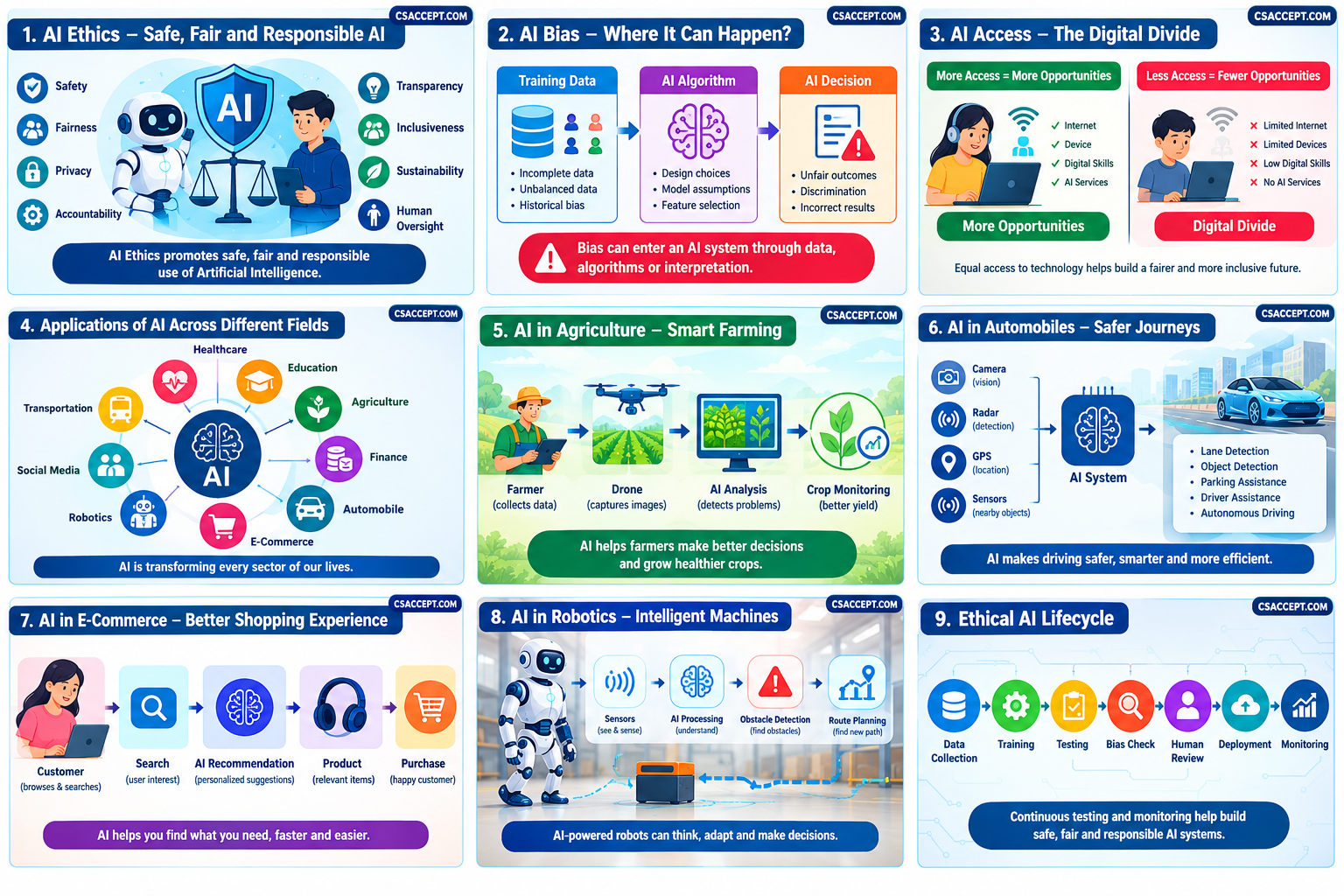
Part 9: Ethical and Social Impact of AI
Positive Effects:
- Improved quality of life
- Faster innovation
- Better decision-making
Negative Effects:
- Privacy concerns
- Bias in AI systems
- Over-dependence on machines
Example:
- AI facial recognition raising privacy issues
Impact:
AI requires responsible use and strong regulations.
Part 10: Future of the World with AI
AI will continue to evolve and reshape the world further.
Expected Changes:
- Fully autonomous systems
- AI-human collaboration
- Smarter governance
- Personalized everything
Example:
- AI doctors, AI teachers, AI legal advisors
Impact:
The future world will be more intelligent, automated, and interconnected.
Conclusion
Artificial Intelligence has dramatically changed the world in almost every field—education, healthcare, business, communication, transportation, and security. While it has brought efficiency, accuracy, and innovation, it also demands ethical responsibility and continuous learning.
AI is not replacing humans; instead, it is reshaping human roles and enhancing human capabilities. The world before AI and the world after AI are completely different—and this transformation is still ongoing.