LAV PRATAP
csaccept.com is a computer awareness website dedicated to providing reliable and easy-to-understand information about computer technology and digital safety. The website focuses on educating students, beginners, and general users about computer basics, cyber security, emerging technologies, and practical IT skills. Through informative articles, quizzes, and real-life examples, csaccept.com aims to increase digital literacy and help users stay safe and confident in today’s technology-driven world.
 Facebook ………………..
  Instagram ……………..
  Twitter ( X ) ……………..
  YouTube
AUTOMATION AND ARTIFICIAL INTELLIGENCE (AI)
1. Introduction
In today’s modern world, technology is growing very fast. Machines are becoming smarter and more efficient. Two important concepts in this field are Automation and Artificial Intelligence (AI). These technologies help in reducing human effort and improving efficiency in different areas like industries, education, healthcare, and daily life.
2. What is Automation?


Definition:
Automation is the use of machines, computers, and technology to perform tasks automatically without human intervention.
Explanation:
Automation works on pre-programmed instructions. It follows a fixed set of rules and performs repetitive tasks again and again without thinking or learning.
Characteristics of Automation:
- Works on fixed rules
- Performs repetitive tasks
- No decision-making ability
- Requires minimal human involvement
- Fast and accurate
Examples of Automation:
- Washing Machine – Automatically washes clothes
- Traffic Lights – Change signals based on time
- ATM Machine – Dispenses cash automatically
- Factory Machines – Assemble products

3. What is Artificial Intelligence (AI)?
Definition:
Artificial Intelligence (AI) is the ability of a machine to think, learn, and make decisions like humans.
Explanation:
AI systems use data, algorithms, and learning techniques to improve their performance. Unlike automation, AI can handle new situations and solve problems intelligently.

Characteristics of AI:
- Can learn from experience
- Can make decisions
- Can solve complex problems
- Mimics human intelligence
- Improves over time

Examples of AI:
- Voice Assistants (Alexa, Google Assistant)
- Self-driving cars
- Chatbots (like ChatGPT)
- Recommendation systems (YouTube, Netflix)

4. Difference Between Automation and AI
| Basis | Automation | Artificial Intelligence |
|---|---|---|
| Definition | Performs tasks automatically | Mimics human intelligence |
| Working | Based on fixed rules | Based on learning & data |
| Thinking Ability | ❌ No | ✅ Yes |
| Learning | ❌ Cannot learn | ✅ Can learn |
| Flexibility | Low | High |
| Decision Making | No | Yes |
| Example | Washing Machine | ChatGPT, Alexa |
5. Real-Life Comparison Example
Washing Machine vs Smart Assistant
- Automation:
A washing machine follows fixed steps (wash → rinse → dry). It cannot change its process. - AI:
A smart assistant understands voice commands, learns user behavior, and gives intelligent responses.
6. Applications
Applications of Automation:
- Manufacturing industries
- Banking (ATM)
- Traffic control systems
- Home appliances
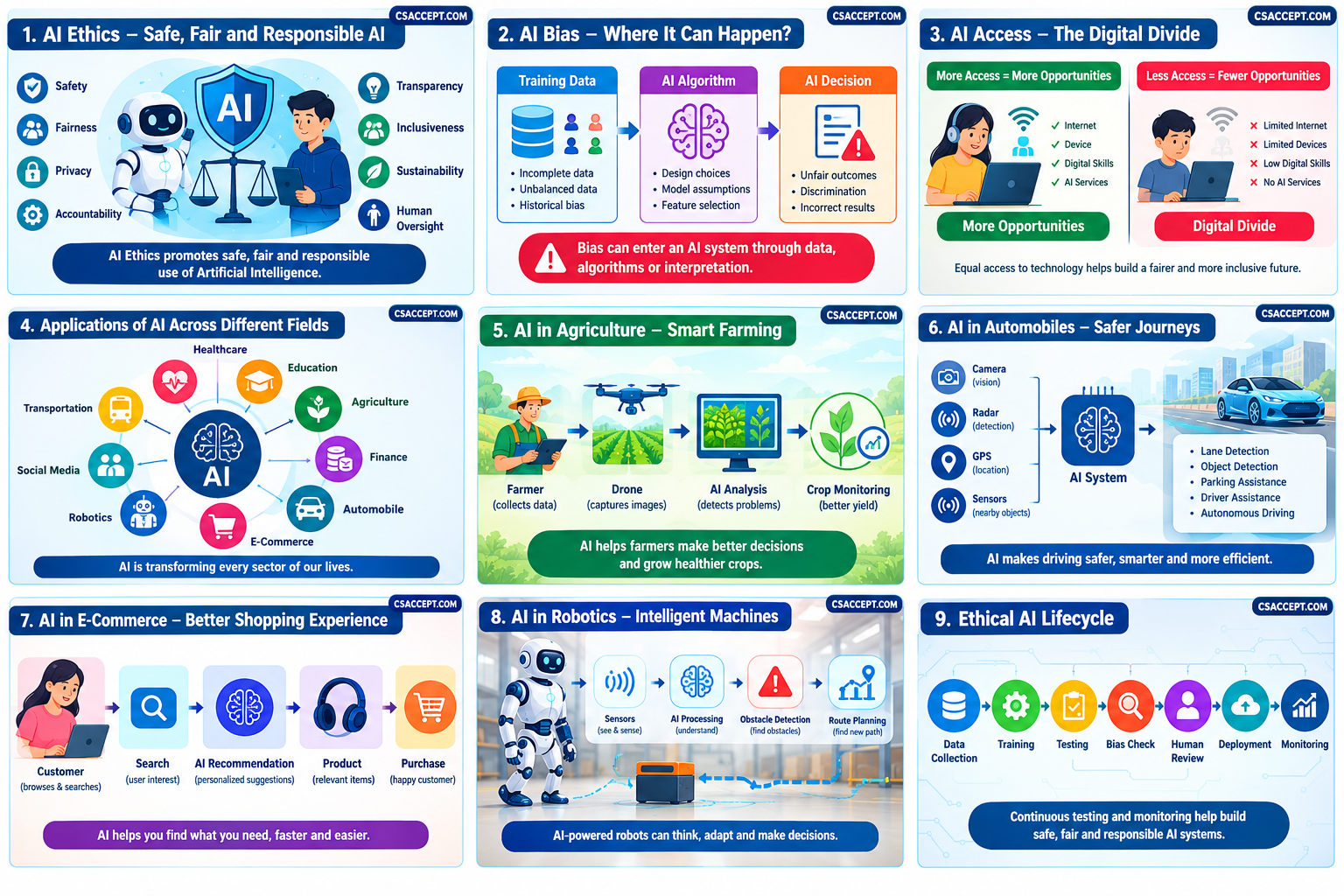
Applications of AI:
- Healthcare (disease detection)
- Education (smart learning apps)
- Transportation (self-driving cars)
- Business (customer support chatbots)
7. Advantages
Automation:
- Saves time
- Reduces human effort
- Increases productivity
Artificial Intelligence:
- Solves complex problems
- Improves decision-making
- Learns and adapts
8. Disadvantages
Automation:
- Cannot handle new situations
- No intelligence
AI:
- Expensive
- Requires large data
- Can replace human jobs
9. Conclusion
Automation and Artificial Intelligence are both important technologies.
- Automation is used for simple and repetitive tasks.
- AI is used for intelligent decision-making and learning.
In simple words:
Automation = Work without thinking
AI = Work with thinking and learning
MCQ Questions
- What is Automation?
a) Manual work
b) Thinking process
c) Use of machines to perform tasks automatically
d) Human intelligence
Answer: 🟢 c) Use of machines to perform tasks automatically - Automation works on:
a) Emotions
b) Fixed rules
c) Random thinking
d) Human brain
Answer: 🟢 b) Fixed rules - AI stands for:
a) Automatic Information
b) Artificial Intelligence
c) Advanced Internet
d) Automatic Intelligence
Answer: 🟢 b) Artificial Intelligence - AI can:
a) Only repeat tasks
b) Learn and make decisions
c) Do nothing
d) Only store data
Answer: 🟢 b) Learn and make decisions - Which is an example of Automation?
a) Alexa
b) ChatGPT
c) Washing Machine
d) Self-driving car
Answer: 🟢 c) Washing Machine - Which is an example of AI?
a) Traffic Light
b) ATM
c) ChatGPT
d) Calculator
Answer: 🟢 c) ChatGPT - Automation has:
a) High flexibility
b) Low flexibility
c) No system
d) Random working
Answer: 🟢 b) Low flexibility - AI improves using:
a) Time only
b) Data and learning
c) Luck
d) Fixed rules
Answer: 🟢 b) Data and learning - Which cannot learn?
a) AI
b) Humans
c) Automation
d) Students
Answer: 🟢 c) Automation - Which can take decisions?
a) Automation
b) AI
c) Machine only
d) Tools
Answer: 🟢 b) AI - ATM is an example of:
a) AI
b) Automation
c) Human work
d) Robotics
Answer: 🟢 b) Automation - AI is used in:
a) Healthcare
b) Education
c) Business
d) All of these
Answer: 🟢 d) All of these - Automation is best for:
a) Complex tasks
b) Repetitive tasks
c) Thinking
d) Learning
Answer: 🟢 b) Repetitive tasks - AI mimics:
a) Animals
b) Machines
c) Human intelligence
d) Tools
Answer: 🟢 c) Human intelligence - Which system learns from experience?
a) Automation
b) AI
c) Traffic light
d) Fan
Answer: 🟢 b) AI - Self-driving cars use:
a) Automation
b) AI
c) Manual system
d) None
Answer: 🟢 b) AI - Automation requires:
a) Full human control
b) No rules
c) Minimal human involvement
d) High thinking
Answer: 🟢 c) Minimal human involvement - AI can solve:
a) Simple tasks only
b) Complex problems
c) No problems
d) Fixed problems
Answer: 🟢 b) Complex problems - Which is smarter?
a) Automation
b) AI
c) Both same
d) None
Answer: 🟢 b) AI - Automation means:
a) Work with thinking
b) Work without thinking
c) Manual work
d) Slow work
Answer: 🟢 b) Work without thinking
Fill in the Blanks
- Automation works on 🟢 fixed rules.
- AI stands for 🟢 Artificial Intelligence.
- AI can 🟢 learn from experience.
- Automation performs 🟢 repetitive tasks.
- AI can make 🟢 decisions.
- Washing machine is an example of 🟢 Automation.
- ChatGPT is an example of 🟢 AI.
- Automation has 🟢 no thinking ability.
- AI uses 🟢 data to improve.
- ATM is used in 🟢 banking.
- AI mimics 🟢 human intelligence.
- Automation requires 🟢 minimal human involvement.
- AI is used in 🟢 healthcare.
- Automation cannot handle 🟢 new situations.
- AI improves 🟢 over time.
True / False
- Automation can think like humans.
Answer: 🟢 False - AI can learn from data.
Answer: 🟢 True - Washing machine is an AI system.
Answer: 🟢 False - AI can make decisions.
Answer: 🟢 True - Automation follows fixed rules.
Answer: 🟢 True - AI has no flexibility.
Answer: 🟢 False - Traffic lights are an example of automation.
Answer: 🟢 True - AI cannot solve complex problems.
Answer: 🟢 False - Automation needs human thinking.
Answer: 🟢 False - Chatbots use AI.
Answer: 🟢 True - Automation can learn new things.
Answer: 🟢 False - AI is used in education.
Answer: 🟢 True - Automation is smarter than AI.
Answer: 🟢 False - AI improves with experience.
Answer: 🟢 True - Self-driving cars use AI.
Answer: 🟢 True